Tichag — the most complex strike in Muay Thai
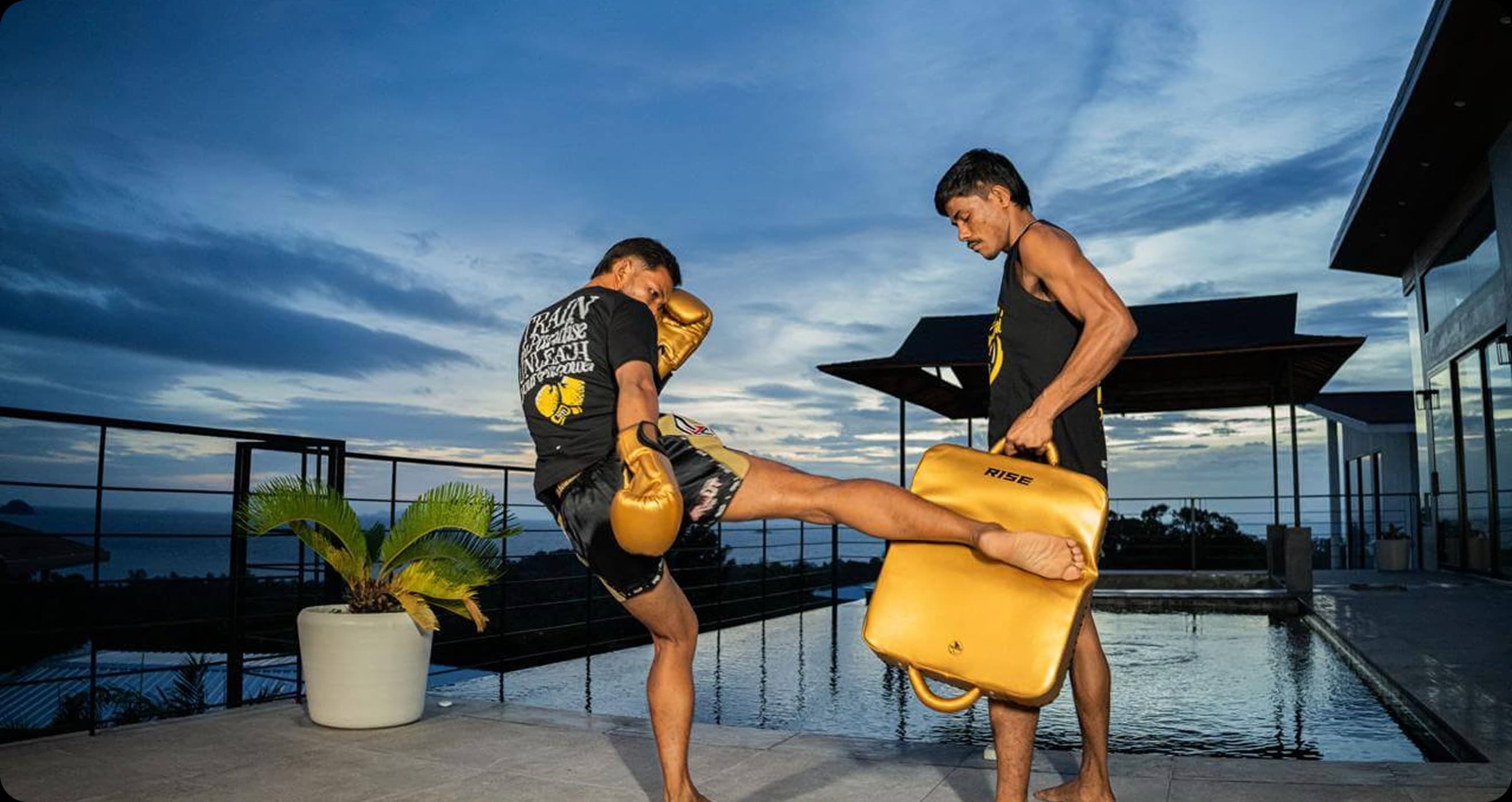
What is tichag and why is it so complex?
Tichag (เตะเข่า) is a jumping knee strike, one of the most spectacular and technically challenging strikes in a Muay Thai fighter's arsenal. This strike has become the hallmark of the great Buakaw. The complexity of tichag lies not in the movement itself, but in the perfect synchronization of all components: acceleration, jump, body rotation, and the final strike.
"Tichag is not a strike. It is the art of creating an explosion in one point of space"
Execution Technique
Phase 1: Preparation and Acceleration
- Assume a stance with weight on the front leg — this will allow you to push off quickly.
- Take a short step forward with the supporting leg, starting to rotate your shoulders.
- Jump up and forward, pushing off with both legs — not just the supporting one.
- At the moment of the jump, start raising the working knee as high as possible.

Correct position in the acceleration phase: weight forward, shoulders starting to rotate.
Phase 2: Jump and Rotation
In the jump, the body should rotate as a whole — from hips to shoulders. Many beginners separate this movement and lose 60–70% of power.
- The arms assist in the rotation — the left pulls back, the right goes forward.
- The gaze is fixed on the target throughout the flight.
- The knee of the working leg rises to the chest at the peak of the jump.
- The body is relaxed — tension appears only at the moment of contact.
Common mistakes of beginners
In my years of coaching, I see the same problems in people who are just starting to learn tichag:

.jpg&w=1920&q=75)
.jpg&w=1920&q=75)
.jpg&w=1920&q=75)
.jpg&w=1920&q=75)
- Jumping only on the supporting leg — you lose height and rotation speed
- Looking down — the head controls the body, if you look down, the strike goes down
- Tensed shoulders — prevent the body from rotating freely
- Knee strike with the kneecap — it hurts you, not the opponent
- Landing on straight legs — risk of injury with every repetition
How to train tichag
- Knee lifts without rotation — 3×15 repetitions daily
- Standing body rotation, mimicking the movement without jumping
- Slow tichag with a partner — focus on technique, not speed
- Full tichag on the bag — gradually increase speed
"Mastering tichag takes 3–6 months of proper training. Each correct repetition makes you better."